Wednesday, March 3, 2010

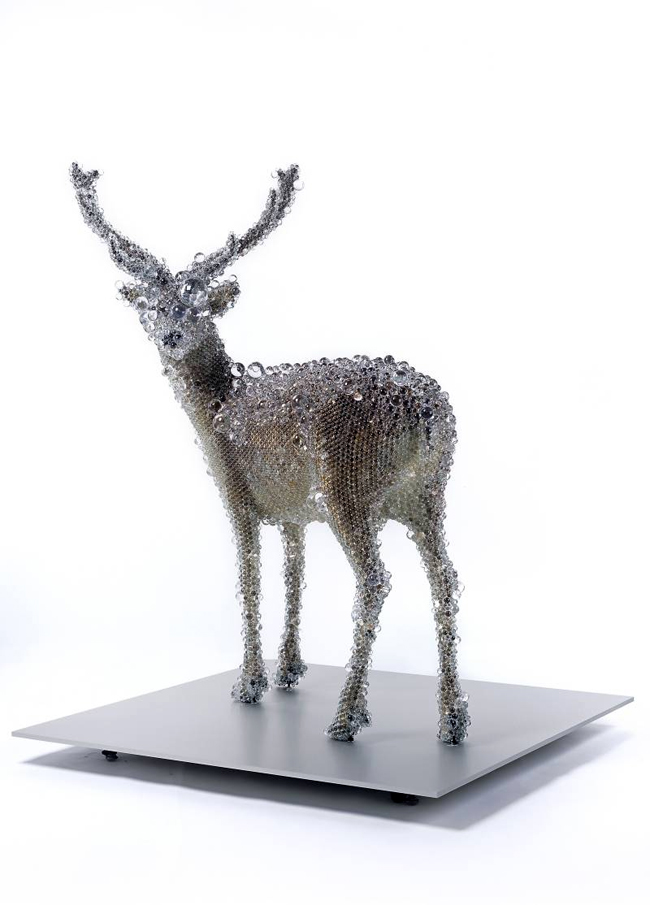
Pixcell

I found an excellent piece of text that gives great insight into Kohei Nawa's Pixcell series:

"He is best known for his ideas of ’skin’ and ‘cells’ encapsulated under the pixcell series. The ’skins’ of objects such as taxidermied animals, sneakers, musical instruments, toys and fake fruit taking on new phases. Countless transparent glass beads encase these objects, forming a new interface between these things and us. the glass beads are ‘cells’ that skew our tactile memories and conventional visual notions we have of these objects. Beads of glass are affixed to and mediate objects. Motifs used for the sculptures are gathered from the internet. entering specific keywords in the search engine results in the display of a myriad of unexpected related images. They cover the surface of these motifs with transparent spheres transforming them into ’shells of light’. Layers of countless ‘cells’ alter the texture and color of the original object, dissolving it into a pixelated image converted and saved into a sculptural format -’pixcell’ – a re-assemblage of element of image."

Monday, March 1, 2010

Kohei Nawa

On Friday's excursion to the 6th Asia Pacific Trianual there was one piece that particularly caught my eye. PixCell by Kohei Nawa.

"By covering surface of an object with transparent glass beads, the existence of the object itself is replaced by "a husk of light", and the new vision "the cell of an image" (PixCell) is shown.
Most of the motifs, like stuffed animals are found through the internet. I search some auction sites and choose from the images which appear on a monitor as pixel. However, the stuffed animals which actually have been purchased and sent have real flesh feel and smell, and have a discrepancy with images on the monitor. I then transpose them to PixCell in turn."


I like how Nawa uses takes an animal, something that we see every day, and changes our perspective of it entirely. He does not change the deer itself, only our perspective of it. This demonstrates Nawa's use of alchemy. He takes an animal, something that is typically a part of every day life and not valued as out of the ordinary, and transforms it into something awe inspiring and new.

Tuesday, February 23, 2010

Dieter Roth

Dieter Roth was a Swiss-German artist that was well knwon for his artist books.
When Roth began making artist books his style was very based around the concept of concrete art. Concrete art is a style of abstract art involving loud, bright colours and geometric shapes that in no way symbolise reality, the concept being that the lines and colours are concrete by themselves. 'Bok' in 1958 is a prime example of Roth's concrete art.

Roth moved away from this concept in 1960. His work began to focus more on art creted from found objects of degradable objects such as newspaper and food. In 1961 he made 'Daily Mirror Book', comprised of Daily Mirror newspaper cut into 2cm x 2cm squares and rebound as a 150 page book. 'Daily Mirror Book' is my favorite artist book by Roth. The book is very inkeeping with my aesthetic. The look of newspaper and printed media has always appealed to me, aswell as the book's simplistic appearance and lack of loud or contrasting colours.

'Daily Mirror Book' is an excellent demonstration of alchemy. Roth composed the book from an old newspaper, transforming it from waste into a work of art, using it to make an ironic statement about literature.

Sunday, February 14, 2010

Artist Books

I have decided that I am going to explore the world of artist books for my body of work in semester one. I have began researching artists such as Rosemarie Chairlone, Kumi Korf and, in more detail, Eileen Wallace.

At this stage I plan on researching Eileen Wallace in further detail, as well as other artists such as Dieter Roth.